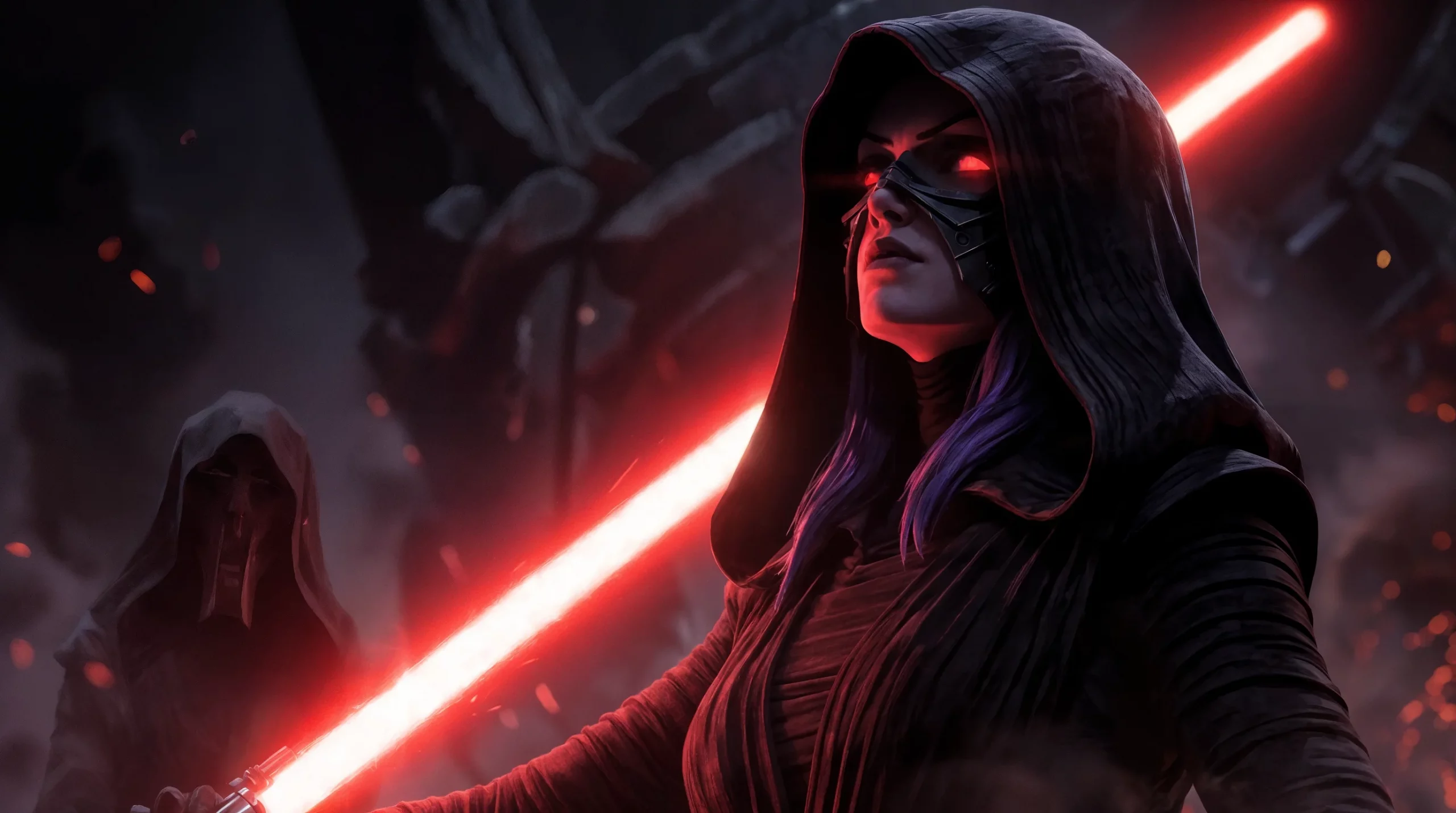
I went in expecting a Sith lord. I got something harder to name. This Maul Shadow Lord review is more complicated than the show deserves credit for getting right.
The setup is clean: Maul hunting down the criminal lords who betrayed him, crossing paths with a surviving Jedi Padawan he wants as his apprentice. What the show does with it is more complicated — and not always in the right way.
The animation is extraordinary. Janix is one of the most fully realised environments Star Wars has ever put on screen. Neon light bleeding through rain-soaked alleys, architecture that looks ancient and criminal at the same time, a colour palette that commits to darkness without losing detail. The visual design alone justifies watching. There are frames in this show that feel painted. You notice them.
Where Maul Shadow Lord Gets Complicated
The show has a genuinely ambitious idea at its centre. Maul — stripped of his master, his Sith title, his place in any order — is a man wearing cruelty as armour. The real Maul, the one the writers seem to want to excavate, carries damage and paranoia beneath the performance of a lord, moments of private collapse hiding just below the surface. In The Clone Wars you saw this twice. A character who could be terrifying precisely because you occasionally glimpsed the cost of being him.
Shadow Lord wants to continue that arc. When it works — in quieter moments, in the paranoia sequences — it’s compelling. The concept is sound: a dark lord using his public menace as a cloak over trauma degradation. The stronger the trauma, the thicker the cloak.
That’s a genuinely interesting character to write.
The problem is that the execution blurs the line between deliberate instability and inconsistency. A Sith lord, even a broken one, operates through long patience and controlled manipulation. Think Sidious. Decades of planning. Calm on the surface, absolute in his objectives. When Maul deviates from that model, it should feel like a crack — a private moment where the armour slips. Instead, the show gives us Maul who tells Devon she may leave, then immediately and directly refuses to let her go, then within minutes loses his temper and physically confronts her. Not a crack. A contradiction. You stop reading it as trauma and start reading it as a character who doesn’t know what he wants.
As a result, he feels less like a Sith lord hiding damage and more like a Sith apprentice pretending to be one.
The Characters the Show Forgot
Devon and her master Daki are the most visible casualties of this pattern.
The show establishes Daki early as a Jedi master of unbroken will — steady, principled, holding his code on a planet that has no use for it. That pattern makes him credible. Then the scene arrives where stormtroopers capture Rylee and Daki questions whether rescuing him will cause more harm than good. The pattern breaks. Not as a deliberate turn. Not as a crack the show earned. Simply an inconsistency the writers didn’t notice, or didn’t care to resolve. The show needed to pick one Daki and commit — either the unbending master who would be the first through the door, or the hollowed old man whose principles have quietly curdled into something self-serving. Either version works. Swinging between them without intention is what doesn’t.
Devon is the more frustrating case. A padawan with fear and anger running underneath her training — that’s not a flaw, that’s a character. However, the show returns to the same beat too many times: she confronts a difficult situation, abandons her objective, runs. Once or twice this reads as realistic. By the fourth or fifth repetition it reads as a writing shortcut. The audience stops seeing her internal conflict and starts seeing the plot pushing her to fail at a convenient moment. She lets Lawson’s son get captured because she’s helping Maul fight — when his safety was her one clear responsibility. That’s not a character making a hard choice. That’s a character the plot moves around the board.
The Vader Problem
There is a moment — and if you’ve watched the season you know exactly which one — where Darth Vader appears.
The audience expects it. Possibly the showrunners felt they needed it. And that’s precisely the problem.
Vader showing up in a Disney+ Star Wars series has become something close to a reflex. He’s everywhere. Obi-Wan Kenobi. Scattered appearances across animation. At this point his cameos don’t generate dread — they generate a kind of weary recognition. Oh. Him again.
But the deeper issue in Shadow Lord isn’t overexposure. It’s logic.
Vader has no reason to chase Maul personally. Maul is not a Jedi. He’s not a rival. He’s not a threat to the Empire’s structure — he’s a rogue criminal lord on a peripheral planet, with Inquisitors already handling him. Vader descending on this situation himself makes no sense for the character. It reads exactly like what it is: a patch. The writers needed a powerful adversary for the finale and therefore reached for the most recognisable name available. Vader because everyone knows Vader. Vader because the audience will react to Vader.
There’s a better version of this scene. A dramatically coherent one. Palpatine appearing himself — not to fight, but to close the account. He trained Maul, discarded him, and let him survive long enough to be useful before watching him become a loose end. An Emperor who finishes his own mistakes personally, or torments them before the end, is far more frightening than Vader doing grunt work. Palpatine has a reason. He has history with Maul. The confrontation means something.
Instead the show gives us Vader with nothing at stake, chasing someone beneath his attention.
It’s the most conventional choice the series makes, in a show that otherwise tries not to be conventional.
What Maul Shadow Lord Actually Is
Maul – Shadow Lord is visually extraordinary and narratively disappointing. Those two things coexist in every episode.
Janix is one of the most fully realised worlds Star Wars animation has produced. The noir atmosphere is committed, the action choreography is some of the best the franchise has offered, and the hand-painted backdrops give the whole season a texture that feels genuinely cinematic. Watch it for the world and you will not regret the time.
Yet this is a show built on character drama — on Maul, on Devon, on Daki — and those characters don’t hold. The central premise was ambitious: a broken Sith lord wearing cruelty as a mask over trauma. The execution, however, turned that mask and the man underneath into the same thing, and the supporting cast got none of the consistency they needed to carry the weight the story placed on them.
A show this visually precise deserved writing with the same standard. It didn’t get it.
Season 2 has the foundation. Whether the writers decide what kind of characters they’re actually telling stories about is the only question that matters now.
